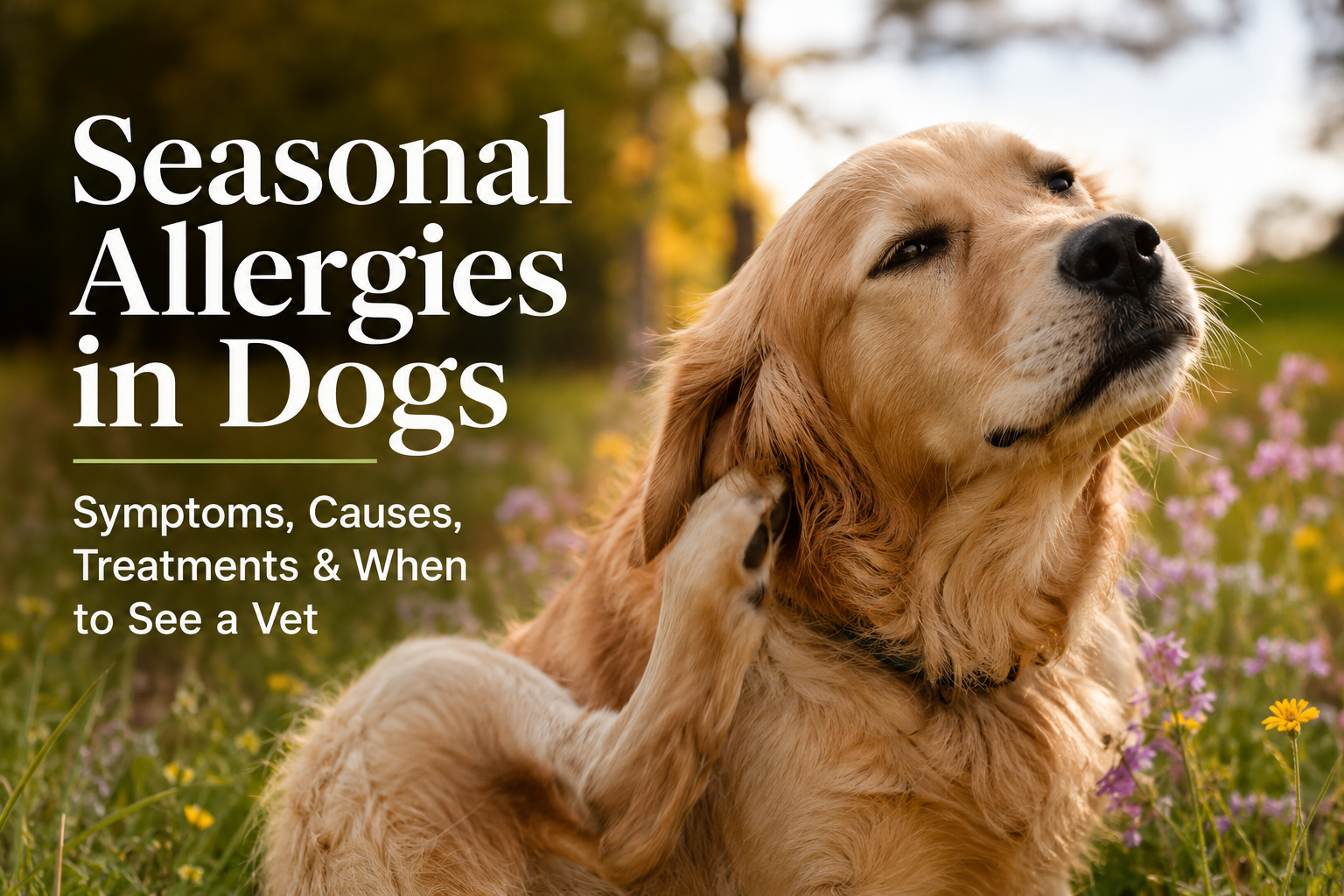
Seasonal Allergies in Dogs: Symptoms, Causes, Treatments & When to See a Vet
When spring flowers bloom or grasses surge in summer, some dogs start scratching, licking their paws, rubbing their faces, or developing recurring ear problems. What owners often call seasonal allergies in dogs may be part of a condition veterinarians call canine atopic dermatitis—a chronic, itchy inflammatory skin disease influenced by genetics, the skin barrier, the immune system, environmental allergens, and sometimes other allergic triggers.
Unlike people, who commonly associate environmental allergies with sneezing and watery eyes, dogs frequently show allergy through their skin and ears. Pollen from grasses, trees, and weeds can contribute to seasonal flares, but dust mites, molds, fleas, secondary skin infections, and food reactions can produce overlapping symptoms.
That overlap matters. An itchy dog should not automatically be diagnosed with “pollen allergies” based on symptoms alone. The American Animal Hospital Association (AAHA) emphasizes that canine atopy is a diagnosis of exclusion: veterinarians first investigate other causes of itching and inflammation.
This guide explains how to recognize seasonal allergy symptoms, what may trigger them, how veterinarians diagnose allergic skin disease, which treatments can help, what owners can safely do at home, and when itching requires veterinary attention.
Important: This article is educational and does not replace veterinary diagnosis or treatment. Persistent itching, painful ears, infected skin, rapidly worsening symptoms, facial swelling, breathing difficulty, collapse, or other severe signs require veterinary attention.
Table of Contents
- What Are Seasonal Allergies in Dogs?
- Common Symptoms
- What Causes Seasonal Allergies?
- Seasonal vs. Food vs. Flea Allergies
- How Veterinarians Diagnose Allergies
- Treatment Options
- Home Care and Prevention
- When to See a Veterinarian
- Common Mistakes
- Myth vs. Fact
- Frequently Asked Questions
- Key Takeaways
- Sources
What Are Seasonal Allergies in Dogs?
“Seasonal allergy” is a useful everyday description, but it is not always a complete diagnosis. Many dogs with recurring environmental allergy signs have canine atopic dermatitis.
The Merck Veterinary Manual describes canine atopic dermatitis as a chronic pruritic condition with characteristic distributions of skin lesions. Susceptible dogs can become sensitized to environmental, food, and/or microbial allergens, and both genetics and abnormalities of the skin barrier may contribute.
Environmental triggers may include:
- Grass pollen
- Tree pollen
- Weed pollen
- Mold-associated allergens
- House dust mites and other indoor environmental allergens
A dog affected mainly by outdoor pollen may worsen during predictable parts of the year. However, seasonality is not absolute. Dogs can encounter multiple allergens simultaneously, indoor allergens may be present throughout the year, and previously seasonal disease can become more persistent.
Why Do Allergies Make Dogs Itch?
Allergic disease involves an inappropriate inflammatory response to substances that would otherwise be harmless. In atopic dogs, interactions between genetic susceptibility, immune responses, allergens, microorganisms, and impaired skin-barrier function can contribute to inflammation and itching.
Scratching then creates another problem: physical damage to the skin barrier. Licking, chewing, rubbing, and scratching can further irritate the skin, while secondary bacterial or yeast overgrowth may intensify inflammation and itching.
This helps explain why a mild seasonal flare can sometimes become dramatically worse. The allergen may have started the episode, but infection and self-trauma can amplify it.
What Are the Symptoms of Seasonal Allergies in Dogs?
The hallmark symptom is itching (pruritus). Owners may notice scratching, licking, chewing, rubbing, or scooting rather than an obvious rash.
| Area | Signs Owners May Notice |
|---|---|
| Paws | Licking, chewing, redness between toes, saliva staining |
| Ears | Head shaking, scratching, redness, odor, discharge |
| Face | Rubbing against furniture or carpet, redness |
| Armpits/groin | Redness, irritation, licking |
| Abdomen | Red or irritated skin, rash-like lesions |
| Skin generally | Scratching, hair loss, sores, crusting or recurrent infections |
Ear Problems Can Be an Important Clue
Recurring inflammation of the external ear canal—otitis externa—can accompany allergic skin disease. A dog that repeatedly develops itchy, red, painful, smelly, or discharge-filled ears needs veterinary assessment rather than repeated unsupervised cleaning.
AAHA recommends ear cytology when ear disease is present because yeast or bacteria may complicate allergic inflammation and affect treatment.
Watch for Secondary Infection
Inflamed allergic skin is vulnerable to secondary problems. Warning signs include:
- Strong or unusual skin odor
- Greasy skin
- Pustules or crusts
- Rapidly expanding redness
- Hair loss
- Darkened or thickened skin with chronic disease
- Pain when the skin or ears are touched
- Persistent licking despite allergy treatment
These signs are important because controlling the allergy alone may not resolve a concurrent bacterial or yeast problem.
What Causes Seasonal Allergies in Dogs?
Pollen is one of the most recognizable seasonal triggers. Trees may release pollen during particular periods, followed by grasses and weeds. Exact pollen seasons depend heavily on geography, climate, rainfall, and local plant species.
But pollen is only part of the picture.
Common Environmental Triggers
- Grass and weed pollens: exposure may occur during walks, outdoor play, or direct skin contact.
- Tree pollens: may contribute to seasonal springtime flares in susceptible dogs.
- Molds: exposure can vary with humidity, vegetation, and indoor conditions.
- Dust mites: indoor exposure can make symptoms less obviously seasonal.
Why One Dog Reacts and Another Does Not
Exposure alone does not mean a dog will develop atopic dermatitis. Many dogs encounter pollen every day without developing allergic skin disease. Susceptibility is influenced by genetics and biological differences involving immune responses and skin-barrier function.
This is why simply trying to remove every environmental allergen is rarely a realistic long-term strategy.
Seasonal Allergies vs. Food Allergies vs. Flea Allergies
One of the biggest diagnostic challenges is that different causes of itching can look remarkably similar.
| Feature | Environmental/Seasonal Allergy | Food Allergy | Flea Allergy |
|---|---|---|---|
| Seasonality | May be seasonal or become year-round | Usually not reliably seasonal | May fluctuate with flea exposure and climate |
| Itching | Common | Common | Often intense |
| Ear disease | Possible | Possible | Less characteristic but possible |
| Diagnosis | History plus exclusion of alternatives | Controlled elimination diet and challenge | Evidence/exposure plus effective flea control |
| Blood/skin allergy testing | Useful primarily for selecting allergens for immunotherapy after diagnosis | Not a substitute for an elimination diet | Usually not the primary diagnostic approach |
Key point: AAHA notes that historical and physical examination findings cannot reliably differentiate atopy from food allergy. That is one reason a properly performed elimination diet trial may be included in the diagnostic process.
How Are Seasonal Allergies Diagnosed in Dogs?
There is no single test that simply says, “Your dog has seasonal allergies.” Diagnosis is systematic.
Step 1: Detailed History
Your veterinarian may ask:
- When did the itching begin?
- Is it seasonal?
- Which body areas are affected?
- Has the dog had recurrent ear disease?
- Which flea and tick preventives are being used?
- What foods, treats, chews, supplements, and flavored medications does the dog receive?
- Which previous treatments helped?
- Are other pets or people in the home itchy?
Step 2: Physical and Dermatologic Examination
AAHA recommends careful examination of areas where inflammation can be subtle, including paws, claws, skin folds, armpits, groin, and the perianal region.
Step 3: Minimum Dermatologic Database
Depending on the individual case, veterinary testing may include:
- Skin cytology
- Skin scrapings
- Flea combing
- Ear cytology when ear disease is present
- Dermatophyte testing when indicated
These tests help identify or exclude parasites, infections, and other diseases that can imitate or complicate allergy.
Step 4: Address Parasites and Secondary Infection
Even when atopic dermatitis seems likely, flea exposure, mites, bacterial infection, and yeast overgrowth may need to be addressed.
Step 5: Consider a Diet Trial
If food allergy remains possible, the veterinarian may prescribe a carefully controlled elimination diet. Success depends on strict compliance: unapproved treats, chews, table scraps, supplements, or flavored medications can compromise the trial.
Step 6: Determine Whether Atopy Fits
After competing explanations have been appropriately investigated, a history and clinical pattern compatible with atopic dermatitis becomes more meaningful.
What About Allergy Testing?
This is frequently misunderstood.
Intradermal skin testing and allergen-specific serum testing do not, by themselves, diagnose canine atopic dermatitis. AAHA specifically states that allergy testing should be used to identify relevant allergens when allergen-specific immunotherapy is being planned—not as a shortcut around the diagnostic process.
How Are Seasonal Allergies in Dogs Treated?
There is no universal “best allergy medicine.” Current veterinary guidance favors an individualized, often multimodal strategy.
| Strategy | Main Goal | Important Consideration |
|---|---|---|
| Anti-itch/anti-inflammatory medication | Reduce itching and inflammation | Choice depends on the individual dog |
| Topical therapy | Support skin and manage localized problems | Products and frequency should match the condition |
| Antimicrobial treatment | Treat confirmed secondary infection | Should be based on veterinary assessment |
| Allergen-specific immunotherapy | Modify response to relevant allergens over time | Requires allergen selection and long-term commitment |
| Environmental management | Reduce avoidable exposure | Complete avoidance is rarely possible |
| Diet trial | Investigate food allergy | Must be performed strictly |
Prescription Anti-Itch Treatments
Veterinarians have several medication classes available for controlling allergic itch and inflammation. The appropriate choice depends on factors such as the dog's age, medical history, severity of symptoms, infections, other medications, speed of relief required, and whether treatment is intended for an acute flare or long-term control.
Prescription options used in canine allergic disease can include medications such as oclacitinib, lokivetmab, corticosteroids, and other immunomodulatory therapies where appropriate.
These are not interchangeable products. Owners should not choose a medication solely because another allergic dog responded well to it.
Allergen-Specific Immunotherapy
Allergen-specific immunotherapy (ASIT) uses selected allergens to gradually modify the allergic patient's immune response. It may be administered according to a veterinary dermatologist's protocol, commonly through injections or sublingual formulations.
Unlike medications whose primary purpose is controlling itch, immunotherapy aims to alter the response to relevant allergens. Improvement can take time, and not every dog responds sufficiently, so owners need realistic expectations and veterinary monitoring.
Bathing and Topical Therapy
Veterinary-directed bathing can be valuable in allergic skin disease. Depending on the dog, topical therapy may help remove material from the coat, support skin-barrier care, soothe irritated skin, or help manage microbial overgrowth.
More shampoo is not automatically better. Excessively frequent bathing with an unsuitable product may dry or irritate the skin. Medicated shampoos also have specific indications and contact-time instructions.
Antibiotics and Antifungals
These medications are not routine treatments for “allergies.” They may be needed when a veterinarian identifies a bacterial or fungal/yeast complication.
Responsible antimicrobial use matters. Treating inflammation without recognizing infection can leave a dog uncomfortable, while unnecessary antimicrobial treatment has its own disadvantages.
How Can You Help a Dog With Seasonal Allergies at Home?
Home care works best as part of a veterinary plan rather than as a substitute for diagnosis.
A Practical Seasonal Allergy Checklist
- Follow consistent veterinarian-recommended parasite prevention.
- Track when scratching and licking increase.
- Check paws, ears, armpits, belly, and skin folds regularly.
- After high-exposure outdoor activity, follow your veterinarian's advice for wiping or rinsing paws and coat.
- Wash bedding regularly.
- Use only veterinary-approved shampoos and topical products.
- Keep prescribed medications on schedule.
- Report new odor, discharge, sores, or painful ears promptly.
- Schedule rechecks rather than repeatedly changing treatments yourself.
Keep an Allergy Diary
A simple record can be surprisingly useful. Track:
- Date
- Itch severity
- Body areas affected
- Ear symptoms
- Outdoor activities
- Medication administration
- Baths
- Diet changes
- Flea prevention
- Any flare or infection diagnosed by your veterinarian
Photos can also document changes between appointments.
When Should You See a Veterinarian?
| Situation | Suggested Action |
|---|---|
| Occasional mild scratching with normal skin | Monitor closely and check for developing signs |
| Persistent licking, chewing, rubbing, or scratching | Arrange a veterinary examination |
| Red, smelly, painful, crusted, or oozing skin | Seek veterinary care promptly |
| Head shaking, ear pain, odor, or discharge | Veterinary examination is recommended |
| Rapid facial swelling, breathing difficulty, weakness, or collapse | Seek emergency veterinary care immediately |
Do not wait until scratching causes extensive wounds. Earlier intervention can help identify parasites or infection and may prevent a flare from becoming harder to control.
A Simple Decision Tree
Is your dog repeatedly itchy?
→ No: Continue routine skin, ear, and parasite care and monitor.
→ Yes: Check for redness, hair loss, ear problems, sores, odor, or persistent paw licking.
→ Any present? Arrange veterinary evaluation.
→ Breathing difficulty, facial swelling, severe weakness, or collapse? Seek emergency veterinary care immediately.
Common Mistakes Owners Make With Dog Allergies
- Assuming every itch is pollen. Fleas, mites, infection, food reactions, and other skin disorders can resemble environmental allergy.
- Buying an allergy test before obtaining a diagnosis. Environmental allergy testing is principally useful for designing immunotherapy after atopic dermatitis has been diagnosed.
- Ignoring the ears. Recurrent otitis may be part of allergic disease and deserves investigation.
- Stopping treatment as soon as the dog improves. Chronic atopic disease often requires long-term management.
- Using human medication without veterinary advice. Formulations, combinations, dosing, contraindications, and interactions matter.
- Changing food repeatedly without a controlled trial. Random diet switching is not equivalent to a diagnostic elimination diet.
- Forgetting parasite prevention. Flea allergy can coexist with other allergies and complicate interpretation of symptoms.
Seasonal Dog Allergies: Myth vs. Fact
| Myth | Fact |
|---|---|
| “Seasonal allergies only make dogs sneeze.” | Dogs commonly show allergic disease through itchy skin, paws, and ears. |
| “An allergy blood test proves my dog has atopic dermatitis.” | Atopic dermatitis is diagnosed from history, clinical signs, and exclusion of competing causes; allergy testing is primarily used to select allergens for immunotherapy. |
| “If symptoms disappear in winter, no veterinary workup is needed.” | Seasonality is useful diagnostic information, but recurring significant itching still deserves investigation. |
| “One treatment should cure allergies permanently.” | Atopic dermatitis is commonly a chronic condition requiring ongoing management. |
| “A food change will fix every itchy dog.” | Food allergy is only one potential cause of pruritus and requires a structured diagnostic approach. |
Pros and Cons of Common Management Approaches
| Approach | Potential Advantages | Limitations |
|---|---|---|
| Environmental management | Low-risk way to reduce avoidable exposure | Complete allergen avoidance is usually impossible |
| Prescription itch control | Can provide substantial symptom relief | Requires individualized veterinary selection and monitoring |
| Topical therapy | Can directly target skin and coat | Requires owner compliance and appropriate product selection |
| Immunotherapy | Targets allergen-specific immune response | Slow onset; response varies; long-term commitment |
| Elimination diet trial | Best-established practical approach for evaluating food allergy | Strict compliance is essential |
Frequently Asked Questions About Seasonal Allergies in Dogs
1. What are the most common signs of seasonal allergies in dogs?
The most characteristic sign is itching. A dog may scratch, lick its paws, chew its skin, rub its face, or develop redness in areas such as the paws, ears, armpits, groin, abdomen, and face. Recurring external ear inflammation can also accompany allergic disease. With ongoing inflammation and self-trauma, owners may notice hair loss, crusting, skin odor, thickened skin, or secondary bacterial or yeast infections. The important point is that these symptoms are not unique to seasonal allergies. Parasites, food allergy, infection, and other dermatologic diseases can cause similar signs, so persistent or recurrent itching warrants veterinary evaluation.
2. What months are dog allergies worst?
There is no universal dog-allergy season. Pollen production depends on geography, vegetation, weather, and climate. A dog sensitive to particular tree pollen may flare at a different time from a dog reacting to grasses or weeds. Indoor allergens such as dust mites may also contribute throughout the year. Keeping a symptom diary across several months can help reveal a pattern. Record itch severity, paw licking, ear problems, outdoor activity, treatments, and flare dates. Your veterinarian can combine that history with the examination and diagnostic workup rather than relying on the calendar alone.
3. Can dogs suddenly develop seasonal allergies?
Yes. Allergic disease does not necessarily become obvious during a dog's first exposure to an environmental allergen. Sensitization and clinical disease develop through complex interactions involving immune responses, genetic predisposition, skin-barrier function, and environmental exposure. Owners may therefore feel that symptoms appeared “suddenly,” even though the underlying process is more complicated. New itching should not automatically be labeled allergy, however. Fleas, mites, skin infections, ear disease, and other conditions can also appear suddenly. A new pattern of persistent itching is a good reason for a veterinary examination.
4. Can seasonal allergies cause ear infections in dogs?
Allergic skin disease can contribute to inflammation of the external ear canal, and secondary microbial problems may develop. Signs include scratching the ears, head shaking, redness, odor, discharge, or discomfort. Because different ear problems can look similar from the outside, veterinarians may perform otoscopy and ear cytology to determine what is happening inside the canal. Repeatedly applying leftover ear medication without an examination is not advisable. Recurring otitis can be an important clue that an underlying allergic condition needs better long-term management.
5. Why does my dog lick its paws during allergy season?
Paws are a commonly affected area in canine atopic dermatitis. Inflammation creates itching, and dogs respond by licking or chewing. Outdoor exposure may also bring the paws into direct contact with grass, plant material, moisture, and environmental allergens. Persistent licking can further irritate the skin and contribute to a cycle of inflammation and secondary infection. Check between the toes for redness, swelling, odor, discharge, sores, or foreign material. Persistent paw licking should be investigated because allergies are only one possible explanation.
6. How do veterinarians test dogs for seasonal allergies?
Diagnosis begins with history and physical examination rather than a single allergy test. AAHA recommends assessing seasonality, itch severity, parasite prevention, previous treatments, and the distribution of lesions, followed by an appropriate dermatologic workup. Cytology, skin scrapings, flea assessment, ear cytology, and other tests may be used to identify competing or complicating conditions. Food allergy may require an elimination diet trial. Once atopic dermatitis has been diagnosed clinically, intradermal or serum allergen testing can help identify allergens for allergen-specific immunotherapy. Those tests should not be interpreted as stand-alone proof that atopic dermatitis is causing a dog's symptoms.
7. Can I give my dog antihistamines for seasonal allergies?
Do not give a dog a human allergy product without veterinary guidance. Even when a particular antihistamine is used in veterinary medicine, effectiveness for canine allergic itch can be limited or variable, and appropriate use depends on the individual dog. Human products may also contain multiple active ingredients or other substances that are inappropriate for pets. More effective veterinary treatments are available for many dogs with significant atopic dermatitis. If your dog is uncomfortable enough to need medication, ask your veterinarian which option best fits the dog's symptoms, medical history, age, and concurrent medications.
8. Does bathing help dogs with seasonal allergies?
Bathing can be a useful component of a broader allergy-management plan. It may help clean material from the coat and allows veterinarians to use topical products chosen for a dog's specific skin condition. However, the ideal product and bathing frequency vary. A dog with secondary microbial overgrowth may need a different topical protocol from a dog whose main problem is dry, irritated skin. Overbathing with harsh or unsuitable products can worsen irritation. Ask your veterinarian about shampoo selection, frequency, water temperature, contact time for medicated products, and whether rinsing paws after outdoor exposure is appropriate.
9. Are seasonal allergies curable in dogs?
Canine atopic dermatitis is generally managed as a chronic condition rather than something expected to disappear permanently after one treatment. The goal is comfortable skin, fewer and less severe flares, control of secondary complications, and a good quality of life. Management may combine prescription itch control, topical care, parasite prevention, infection management, environmental strategies, and allergen-specific immunotherapy. Treatment often changes over time as seasons, exposures, infections, and the dog's health change. Well-managed dogs can still experience occasional flares, which does not necessarily mean the entire treatment plan has failed.
10. Can food allergies look like seasonal allergies?
Yes. Food allergy and environmental atopic dermatitis can produce overlapping patterns of itching and skin or ear disease. AAHA notes that history and physical findings alone cannot reliably distinguish atopy from food allergy. When food allergy is a realistic possibility, veterinarians may recommend a controlled elimination diet followed by an appropriate challenge to assess response. Simply changing among over-the-counter foods is not equivalent to a diagnostic diet trial because ingredient exposure and compliance matter. Some dogs can also have more than one allergic problem simultaneously.
11. Should I wipe my dog's paws after walks?
For some dogs, gently cleaning or rinsing the paws after high-exposure outdoor activity may be a reasonable part of environmental management, especially when recommended by the dog's veterinarian. It should not be presented as a cure for atopic dermatitis, however. Environmental allergens are difficult to avoid completely, and inflammation may persist even with careful cleaning. Avoid aggressive scrubbing or repeatedly applying fragranced wipes to already inflamed skin. If the paws are red, swollen, painful, smelly, or persistently itchy, veterinary assessment is more important than simply increasing cleaning.
12. When are dog allergy symptoms an emergency?
Routine seasonal itching is different from an acute severe allergic reaction. Seek emergency veterinary care for signs such as breathing difficulty, rapidly developing facial or muzzle swelling, collapse, marked weakness, or other rapidly worsening systemic symptoms. Severe skin pain or extensive wounds also deserve prompt attention. For non-emergency allergic skin disease, schedule a veterinary visit when itching persists, disrupts sleep, causes hair loss or sores, or is accompanied by ear problems, odor, discharge, or recurrent infections. Early assessment can identify complications before they become harder to manage.
Key Takeaways
- Seasonal allergies in dogs commonly appear as itchy skin, paw licking, face rubbing, and ear problems rather than primarily respiratory symptoms.
- Environmental allergens can include pollen, molds, and dust mites.
- Symptoms alone cannot prove that pollen or another environmental allergen is responsible.
- Canine atopic dermatitis is a diagnosis of exclusion.
- Fleas, mites, secondary infection, and food allergy can imitate or worsen environmental allergic disease.
- Intradermal and serum allergen testing are primarily used to select allergens for immunotherapy after an appropriate clinical diagnosis; they do not independently diagnose atopic dermatitis.
- Treatment is usually multimodal and individualized.
- Recurring ear disease deserves investigation.
- Atopic dermatitis commonly requires long-term management, although individual dogs may have strongly seasonal flares.
- Rapid facial swelling, breathing difficulty, collapse, or severe systemic signs require emergency veterinary care.
Suggested Internal Links for Happy Paw Studio
- Why Is My Dog Itching? A Complete Guide to Scratching and Skin Problems
- Dog Ear Infections: Symptoms, Causes, Treatment and Prevention
- Food Allergies in Dogs: Elimination Diets Explained
- How Often Should You Bathe a Dog?
- Fleas on Dogs: Signs, Treatment and Prevention
- Why Do Dogs Lick Their Paws?
- Healthy Dog Skin and Coat: The Complete Owner's Guide
Conclusion
Seasonal allergies can turn beautiful weather into an uncomfortable cycle of scratching, licking, inflamed paws, and recurring ear trouble for susceptible dogs. The most important lesson is that itching is a symptom, not a diagnosis.
A strong treatment plan begins by determining what is actually contributing to the itch. Parasites, infections, food reactions, environmental allergies, and other skin disorders can overlap, and some dogs have more than one problem at the same time.
Once canine atopic dermatitis has been appropriately diagnosed, modern veterinary medicine offers multiple ways to improve comfort. Prescription anti-itch therapies, topical skin care, management of secondary infections, consistent parasite prevention, environmental strategies, and allergen-specific immunotherapy can all have roles depending on the individual patient.
For owners, one of the most useful things to do is watch for patterns. Record when symptoms occur, photograph skin changes, monitor the paws and ears, keep parasite prevention consistent, and seek veterinary care before a mild flare becomes severe.
Seasonal allergies may require ongoing management, but persistent itching should never simply be accepted as “normal for this time of year.” A comfortable dog is the goal—and finding the real causes behind the itch is the first step toward getting there.
Sources
- American Animal Hospital Association (AAHA) — 2023 Management of Allergic Skin Diseases in Dogs and Cats Guidelines
- AAHA — Diagnosing Allergic Skin Disease in the Canine Patient
- AAHA — Allergic Skin Diseases Toolkit
- AAHA — Allergic Skin Diseases in Canines: Managing Allergy Flares
- Merck Veterinary Manual — Atopic Dermatitis in Dogs
- Merck Veterinary Manual — Allergies in Dogs
- Cornell University College of Veterinary Medicine — Canine Allergic Disease
- Companion Animal Parasite Council — Flea Guidelines
- American College of Veterinary Dermatology — Veterinary Dermatology Resources and Position Statements
- U.S. Food and Drug Administration — Animal Drug Safety-Related Labeling Changes
Get Printable Dog Planners & Trackers at Happy Paw Studio
Looking for instant printable dog health logs, pet care planners, and daily routine journals? Visit our Etsy store to download yours today!
Shop HappyPawStudio1 on Etsy →