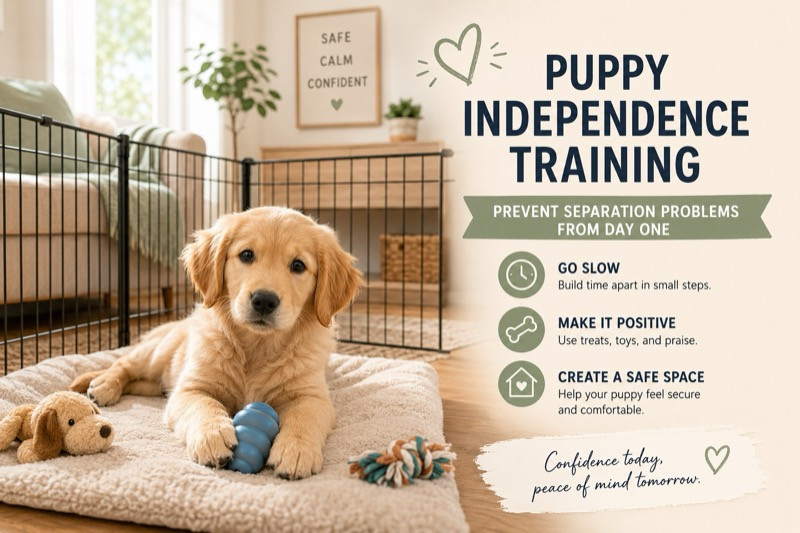
Bringing home a puppy often means spending a great deal of time together. That closeness helps your puppy settle in, but it is also important to teach them that short periods apart are safe and normal.
Puppy independence training does not mean ignoring your puppy or leaving them to “cry it out.” It means introducing alone time gradually, keeping each session manageable, and returning before your puppy becomes seriously distressed. Over time, your puppy learns that separation is temporary and that they can relax without constant contact.
Start with seconds or minutes while you are still at home. Use a comfortable puppy-safe space, provide an appropriate activity, and increase the distance and duration only while your puppy remains calm. Animal-welfare guidance consistently recommends building alone time in small stages rather than suddenly leaving a new puppy for a long period.
What Is Puppy Independence Training?
Puppy independence training teaches a young dog to rest, play or chew safely without needing continuous interaction from a person.
The goal is not to make your puppy emotionally detached. Healthy attachment and healthy independence can exist together. Your puppy should feel secure with you while also learning that they can cope when you move across the room, go upstairs or briefly leave the house.
Useful independence skills include:
- Resting in a bed, pen or puppy-proofed area
- Staying calm when you walk out of sight
- Entertaining themselves with a safe toy
- Settling after normal household activity ends
- Remaining relaxed during brief departures
- Coping with everyday departure cues, such as keys or shoes
These skills should be taught deliberately. A puppy who has never experienced manageable alone time cannot be expected to understand an abrupt, hours-long absence.
Why Puppies May Struggle With Being Alone
A newly adopted puppy has recently left their mother, littermates or previous home. They are adjusting to unfamiliar people, sounds, routines and sleeping arrangements. Being alone may therefore feel confusing or unsafe at first.
Some protest is not unusual during this transition. However, repeated experiences of intense fear can make alone time harder rather than easier. The aim is to keep training below the point at which your puppy becomes overwhelmed.
Puppies also differ considerably. One puppy may relax behind a baby gate within a few days, while another may need a much slower process. Blue Cross advises moving at the individual puppy’s pace and returning to the last comfortable duration when signs of worry appear.
Start When Your Puppy Is Settling In
You can begin introducing tiny moments of independence soon after your puppy arrives, but the first priority is helping them feel safe.
During the early days:
- Establish predictable meals, toilet breaks and rest periods.
- Give your puppy a comfortable sleeping area.
- Keep training sessions brief.
- Avoid overwhelming them with too many new experiences at once.
- Make sure their physical and social needs are being met.
Independence training works best when your puppy is comfortable, has recently toileted and is ready to settle. It is much harder for a hungry, overtired, frightened or energetic puppy to relax alone.
Create a Comfortable Puppy-Safe Area
Choose a safe space where your puppy can rest without having access to hazards. Depending on your home and your puppy, this might be:
- An exercise pen
- A puppy-proofed room
- An area divided by a baby gate
- A crate with the door open
- A crate used for short periods after positive training
Include comfortable bedding, fresh water when appropriate and one or two safe enrichment items. Remove electrical cords, small objects, toxic plants, cleaning products and anything your puppy might swallow.
A crate should never be used as punishment. Welfare guidance recommends turning it into a comfortable resting place with suitable bedding and safe chew items. Some puppies feel secure in a crate, while others become more distressed when confined, so pay attention to the individual dog rather than assuming one setup suits every puppy.
Step 1: Reward Calm Behavior Near You
Independence begins before you leave the room.
Give your puppy a safe chew, stuffed food toy or a few pieces of their regular food on a mat. Sit nearby without continuously talking to, touching or entertaining them.
When your puppy settles, calmly place a treat between their paws or offer quiet praise. You are teaching them that relaxing independently is rewarding.
Avoid waiting until your puppy demands attention and then immediately starting an exciting game. Instead, notice and reinforce moments when they choose to lie down, investigate a toy or rest without help.
Step 2: Add a Small Barrier
Once your puppy can relax near you, place them behind a baby gate or inside an exercise pen with an enjoyable activity.
Stay visible at first. Continue an ordinary task such as reading, preparing food or working nearby. After a short period, open the barrier while your puppy is still calm.
Blue Cross recommends beginning with the puppy behind a stair gate while the owner remains within sight and earshot, then gradually increasing the time before moving completely out of view.
The barrier should not predict abandonment. Sometimes close it while you remain nearby, and sometimes leave it open while your puppy rests.
Step 3: Move Around the Room
When your puppy is comfortable behind the barrier, begin moving around.
Take one or two steps away, then return. Sit down, stand up, walk to a shelf or briefly turn your back. Keep the movements ordinary and calm.
At first, return before your puppy follows, cries or becomes concerned. Gradually vary your distance rather than increasing it in a perfectly straight line.
For example:
- Two steps away
- One step away
- Four steps away
- Sit nearby
- Walk to the doorway
- Return to the chair
This variation helps prevent the exercise from becoming increasingly difficult every single time.
Step 4: Disappear for a Few Seconds
Next, step out of view for one or two seconds and return.
If your puppy remains relaxed, repeat the exercise several times with breaks between sessions. You might then try three seconds, one second, five seconds and two seconds.
Do not rush from a few seconds to several minutes. Many successful repetitions at an easy level are more helpful than one departure that causes panic.
Return calmly. There is no need to ignore your puppy, but avoid turning every reunion into an intense event. The message should be that leaving and returning are both normal parts of daily life.
Step 5: Practise Departure Cues
Puppies quickly notice patterns. Picking up your keys, putting on shoes or reaching for a bag may start predicting that you are about to leave.
Practise these actions when you are not going anywhere:
- Pick up your keys and put them down.
- Put on your shoes and make tea.
- Open the front door, then close it.
- Carry your bag into another room.
- Put on a coat and sit down.
Blue Cross specifically recommends desensitising puppies to departure cues when items such as keys, coats or bags begin to cause worry.
Keep these exercises casual. The aim is to make the cues less meaningful, not to tease or repeatedly alarm your puppy.
Step 6: Begin Very Short Departures
Once your puppy can relax while you are out of sight inside the home, briefly step outside.
Start with an absence your puppy can comfortably handle. This may be only a few seconds. Stand outside the door, return quietly and continue your normal routine.
Gradually build from seconds to a minute or two. Increase the time only when your puppy remains comfortable at the current level.
The RSPCA recommends training dogs to stay home alone through a gradual process and advises against punishment. Blue Cross similarly recommends returning before the puppy becomes anxious and reducing the duration if worry appears.
Use a Camera to See What Really Happens
A pet camera, spare phone or home security camera can show whether your puppy truly settles after you leave.
Watch for:
- Relaxed chewing
- Sniffing and exploring
- Lying down
- Briefly checking the door, then settling
- Normal position changes during rest
Possible signs of distress include:
- Persistent barking, whining or howling
- Repeated pacing
- Panting when the room is not hot
- Scratching or biting doors
- Frantic attempts to escape
- Refusing a normally valuable food toy
- Drooling
- Toileting associated with the departure
- Remaining highly alert and unable to settle
Separation-related distress often appears soon after departure. AVSAB notes that recording the first 30–60 minutes can reveal both obvious behavior and subtler signs such as restlessness, lip licking, panting and whining.
How Quickly Should You Increase Alone Time?
There is no universal timetable.
Increase alone time according to your puppy’s behavior, not according to a deadline. One puppy may progress from a few seconds to several minutes quickly. Another may need many repetitions at the same duration.
A practical pattern is:
- Start with a duration your puppy handles easily.
- Repeat it several times across the day.
- Add only a small amount of time.
- Mix easier repetitions with slightly longer ones.
- Reduce the duration if your puppy shows concern.
Do not repeatedly test your puppy’s maximum. Training should build confidence, not discover the exact point at which they panic.
Meet Your Puppy’s Needs Before Training
Your puppy is more likely to settle when their immediate needs have been met.
Before an alone-time session:
- Take them outside to toilet.
- Offer an age-appropriate amount of play or gentle activity.
- Give them time to calm down afterward.
- Make sure they are not hungry or thirsty.
- Choose a naturally quieter part of their routine.
Avoid using intense exercise to exhaust a puppy. Growing dogs need appropriate activity and plenty of sleep. A calm sniffing game, short reward-based training session or gentle play may be more suitable than highly arousing exercise immediately before you leave.
Use Food Carefully
A safe stuffed toy, chew or food puzzle can help create a positive association with alone time.
Use part of your puppy’s normal meal when possible so that training does not add excessive calories. Choose items suited to your puppy’s age, size and chewing style, and test them under supervision before leaving them with one.
Food is useful, but it should not be used to disguise distress. If your puppy normally loves the item but stops eating as soon as you leave, that may indicate the exercise has become too difficult.
Teach Rest as Well as Play
Some owners focus so heavily on entertainment that their puppy never learns to switch off.
Build quiet periods into the day. Dim the activity level, offer a comfortable resting place and allow your puppy to sleep without constant interaction.
Puppies need substantial rest, and overtired puppies often become more restless, mouthy or vocal. Independence training is easier when calm downtime is already part of the household routine.
Common Puppy Independence-Training Mistakes
Leaving Too Much, Too Soon
A full workday is not an appropriate first alone-time lesson. Begin with tiny absences and arrange help when your puppy cannot yet manage the time you need to be away.
Waiting Until the First Long Absence
Start practising while you still have flexibility. Do not wait until the morning you must leave for several hours.
Letting the Puppy Become Extremely Distressed
Repeated panic does not teach independence. It teaches that being alone is frightening.
Using the Crate as the Only Solution
A crate can be useful for some puppies, but it does not treat fear. A puppy who panics in a crate may need a pen, gated room or different plan.
Punishing Barking or Destruction
Punishment after you return cannot teach your puppy what to do while alone. It may increase fear and make reunions less predictable. Reward-based methods are recommended for training and behavior work.
Increasing the Duration Every Time
Training does not need to become harder with every repetition. Mix short, easy absences with occasional modest increases.
Expecting Food to Fix Everything
A puzzle toy can support training, but it cannot make an overwhelmed puppy feel safe.
Independence Training and Toilet Needs
Young puppies have limited bladder and bowel control. A puppy who toilets while left alone may simply have been left longer than they can physically manage.
Plan departures around toilet breaks and arrange for a trusted person to help when necessary. Age-based charts can provide rough estimates, but individual puppies differ, and excitement, sleep, water intake, health and previous toilet training all affect how long they can wait.
Do not punish accidents. Clean them thoroughly and adjust the routine.
What Is Normal Protest, and What Is a Warning Sign?
A brief whine followed by settling may be part of learning. Persistent or escalating distress is different.
Pause the training and make the next session easier if your puppy:
- Becomes increasingly vocal
- Cannot engage with food
- Tries frantically to escape
- Pants, drools or trembles
- Remains distressed throughout the absence
- Begins reacting fearfully to departure cues
- Injures themselves
- Shows a sudden change from their usual behavior
Video can help you distinguish a short complaint from sustained anxiety.
When to Seek Professional Help
Contact your veterinarian if your puppy shows severe distress, injures themselves, has sudden behavior changes or cannot tolerate even very brief separation.
Medical problems can influence behavior, so a veterinary assessment is an appropriate first step. Your veterinarian may then recommend a qualified reward-based trainer or a veterinary behavior professional.
Seek help early rather than repeatedly exposing your puppy to panic. Blue Cross recommends contacting a veterinarian or qualified behavior professional when behavior problems develop, as early support can prevent them from becoming more established.
A Simple Daily Independence Routine
The following example can be adjusted to suit your puppy:
Morning
After toileting and breakfast, place your puppy in their safe area with a small food toy while you remain nearby for two minutes.
Midmorning
Practise five very short out-of-sight repetitions, ranging from one to five seconds.
Afternoon
Give your puppy a chew in their pen while you move around the room for several minutes.
Early Evening
Practise picking up keys, opening the door and sitting back down without leaving.
Later Evening
After a toilet break, step outside for one comfortable, camera-monitored departure.
Keep the sessions easy enough that your puppy succeeds. Several calm moments throughout the day are more useful than one difficult test.
Frequently Asked Questions
When should I start puppy independence training?
You can begin with very short, gentle exercises once your puppy is starting to feel secure in the home. Initially, this may simply mean rewarding them for resting on a bed while you sit nearby.
Should I let my puppy cry until they stop?
Do not deliberately leave a puppy in escalating distress. If crying continues or intensifies, reduce the difficulty and return to a duration they can manage. The goal is gradual learning, not forced endurance.
Can I use a crate for alone-time training?
Yes, when your puppy has been positively introduced to the crate and can relax inside it. However, crates are not suitable for every puppy, and confinement can worsen distress in some dogs. A pen or puppy-proofed room may work better.
How long can a young puppy be left alone?
There is no single safe duration for every puppy. Age, toilet control, health, training history and emotional comfort all matter. Begin with seconds or minutes for training and arrange human help for absences beyond your puppy’s present physical and emotional capacity.
Why does my puppy ignore the food toy after I leave?
Loss of interest in a normally exciting reward can be a sign that your puppy is worried. Make the next departure shorter or easier and observe them on camera.
Will independence training guarantee my puppy never develops separation anxiety?
No training can guarantee that a dog will never develop a behavior problem. Genetics, early experiences, health, environmental changes and individual temperament can all play a role. Gradual independence practice can, however, help your puppy develop useful coping skills.
Conclusion
Puppy independence training is built through small, successful experiences. Start while you are still in the room, introduce a comfortable barrier, step briefly out of sight and progress to short departures only when your puppy remains relaxed.
Move at your puppy’s pace, use reward-based methods and avoid leaving them for longer than they can physically or emotionally manage. A safe area, predictable routine, appropriate enrichment and calm repetition can help your puppy learn that time apart is ordinary and temporary.
If your puppy shows persistent fear, frantic escape behavior or an inability to settle, speak with your veterinarian and seek qualified behavior support rather than continuing to increase the duration.
For more practical puppy-care and positive-training guidance, explore the latest advice from Happy Paw Studio.
Sources
- American Veterinary Society of Animal Behavior: Humane Dog Training Position Statement
- American Veterinary Society of Animal Behavior: How to Tell if Your Dog Has Separation Anxiety
- Blue Cross: Preventing Separation Anxiety in Puppies
- Blue Cross: What to Do if Your Dog Has a Behaviour Problem
- RSPCA: How to Train Your Dog to Stay Home Alone
- RSPCA: How to Crate Train a Puppy
Get Printable Dog Planners & Trackers at Happy Paw Studio
Looking for instant printable dog health logs, pet care planners, and daily routine journals? Visit our Etsy store to download yours today!
Shop HappyPawStudio1 on Etsy →